Monday, 23 December 2013

Flashback 1977 (part one) - ROCKY, CARRIE, GRIZZLY, SWEENEY!

A look at British movie magazines published in 1977. This was probably the peak of my cinemagoing years, at least weekly. I've several magazines from each month and there's plenty of great adverts in them, so this year will be spread over two posts because it's so picture-heavy. And speaking of heavy... 


January, Photoplay Film Monthly
1933, 1976, 2005... every thirty years, a new version of King Kong! But this was my first Kong, as I'd somehow missed the original on TV before then. The publicity for this had been exciting, especially the news of a full-sized Kong robot, built by Carlo Rambaldi. After seeing the film though, his name wasn't a watchword for quality. Not until he worked on something more convincing, which he did with Close Encounters, Alien and E.T..


The producers played down the fact that for almost all of the movie, Kong was played by a man in a suit. Despite the lack of credit in the publicity material, they used Rick Baker in the suit (that he also built) for most of their publicity photos - like the shot on this cover (above). Baker was about to become a special make-up effects legend, wowing the world with his transformation and zombie prosthetics for An American Werewolf in London and later perfecting his ape suits for Gorillas in the Mist.


January, Films and Filming
While lazily thinking that The Texas Chain Saw Massacre was a movie from 1974, it was a surprise to find Films and Filming reviewing it in January 1977 (above)! This single page led me to do a little research and write about the infamous horror film's rocky reception in the UK.

January, Film Review
Especially weird that, because The Texas Chain Saw Massacre didn't get a usual nationwide release, movie magazines were running sensationalist adverts for horror films Schizo and Survive, while Chain Saw wasn't even mentioned and no adverts appeared in Photoplay or Film Review magazines to herald its release in cinemas.


Marathon Man got a great head start with the publicity from William Goldman's bestselling novel. The movie adaption is a superbly tight thriller with a great cast, including Dustin Hoffman, Marthe Keller and Laurence Olivier (with William Devane and Roy Scheider in supporting roles!). It benefits greatly from the many New York City locations.
January, Films and Filming


January, Film Review
I'm not suggesting you see Elizabeth Taylor in The Blue Bird, it's just that this is a photo of her and a young Patsy Kensit!


January, Film Review
The Enforcer. Shouldn't that be, 'Clint Eastwood is still Dirty Harry?'


January, Films Illustrated
I bought this issue of Films Illustrated because of this colour photo from the climax of Carrie. Filming this scene, Sissy Spacek remembers that she was to remain on stage until it became too hot for her - that was her cue to leave the stage. She waited long enough for the hairs on the back of her neck to be singed!

February, Film Review
Carrie was one of my favourite ever cinema experiences, making every other Brian De Palma film a must-see (well, until Wise Guys, anyway).


February, Film Review
While US movies were moving to photographic posters, the UK were making do with painted artwork like this one for the first Sweeney movie, which makes it look like a boys' comic!


February, Film Review
Simple poster for Scorsese's Taxi Driver. If someone could explain how Jodie Foster continued making Disney movies after appearing in this, I'd love to hear it!


February, Photoplay Film Monthly
The wonderful Grizzly, at one point going to be called 'Claws', is basically Jaws on land. With about as much gore - but not in UK cinemas. The widescreen DVD was my first chance to see the bloody mayhem. This has now been promised on blu-ray...

More about Grizzly, here.


March, Film Review


March, American Cinematographer
It only took a couple of films for word of mouth to save Garrett Brown the need to advertise his revolutionary way of producing smooth tracking shots without the need for laborious laying of tracks. The Steadicam mount also meant that the camera could move smoothly around corners and give more lifelike point-of-view shots. His work would be showcased extensively in The Shining, particularly the low angle shots of Danny roaming the corridor and running through the maze, not to mention the opening 'long-take' murder in Halloween.


By the time Network was released, Peter Finch was already dead. His performance as Howard Beale, the news announcer who melts down on air but drives the ratings up, won him a posthumous Academy Award.
March, Films and Filming
Faye Dunaway's ruthless TV executive still resonates today as the battle for ratings continues to exploit celebrity meltdowns...


March, Films Illustrated
A typical 'quotes' poster that tells you how good a movie is without letting you know what it's about. This is rare for Woody Allen as he's not directing and it's based on the true stories of blacklisted writers who used other writers' names to get their work commissioned. While Woody plays opposite Zero Mostel, this is as serious as it is funny.


Not content to have a fast-moving action/comedy/romance, Colin Higgins had to add a huge 'disaster movie' scene. An early case of a story being 'Bruckheimered'. A lot of fun, the first film to team up Gene Wilder and Richard Pryor, but strangely not often mentioned alongside their later comedy double-acts. Richard Kiel also appears here as a silent killer henchman with silver-teeth, before being cast in The Spy Who Loved Me.

More about Silver Streak, here.


June, Film Review
Zoltan - Hound of Dracula. What a silly film. Would make a great double-bill with Devil Dog - Hound of Hell though.


June, Film Review
This looked too fierce and transgressional to tempt me into the cinema at the time. Don't think I could have coped with the opening newsreel scenes as a teenager (I'm assuming it was left intact in UK cinemas).

As an adult, I really appreciated its uncompromising ferocity as ahead of its time, with a unique tone that failed to be replicated in the recent remake.


June, Films Illustrated
Tentacles needed a lot more money to live up to the concept of a giant killer octopus. It's still bonkers-watchable for the incredible cast coping with a bloody awful script. Bo Hopkins should get some sort of Bad Oscar for his heartfelt speech to his killer whales. Catchy score from Stelvio Cipriani though.


April, Film Review
As we've seen (Taxi Driver above) Jodie Foster was already in demand, here starring in creepy Canadian thriller The Little Girl Who Lives Down The Lane. The story of this not-so-little girl living with her dad on the edge of town, trying to fend off the attentions of predatory paedo (Martin Sheen) is still very watchable.

More about The Little Girl Who Lives Down The Lane, here.


June, Film Review
After two adult thrillers, Jodie's back again as the lovable tomboy who swaps bodies with her mum (Barbara Harris). Elements of the story had been done before, but this was the first Freaky Friday and years before Big. Jodie on a skateboard!

June, Film Review


June, Film Review
By the time the UK got Rocky, the publicity could wave all its Oscars at us. Then sports movies suddenly got big...


June, Photoplay Film Monthly
Director Dan Curtis was better known for his TV series (Dark Shadows, Kolchak - The Night Stalker) and creepy TV movies (Trilogy of Terror) but based on Burnt Offerings, should have been given more movies. Oliver Reed, Karen Black, Bette Davies and Lee Montgomery are all impressive.

I compare Burnt Offerings to The Shining, here.


July, Films Illustrated
This had flack at the time for the bad language - something hard to imagine now. Now it comes over as an honest portrayal of locker room talk. What keeps Slap Shot interesting is the desperate story of the small town ice hockey team mixed with offbeat pre-Animal House humour. It also bears comparison with Parker and Stone's Baseketball

More about Slap Shot here.


July, Films Illustrated
The cast alone makes this worth a watch, not to mention the extensive location work. The massive WWII operation recreated, is undercut by not being famous as anything pivotal in the history of the war. One of many impressively sprawling epics directed by Richard Attenborough.

July, Films Illustrated


Part Two of 1977 is here...


Saturday, 21 December 2013

Flashback 1977 (part two) - STAR WARS, SORCERER, EXORCIST II...

1977 is spread over two posts because it's too picture-heavy for just one...


August, Film Review
Car Wash is a freewheeling slice-of-life comedy, with a little drama thrown in - a 'day in the life' of the employees and patrons of an L.A. car wash. A few years earlier, this may have been included as blaxploitation because of the mostly black cast, but the comedy and the UK chart invasion by Rose Royce tracks from the soundtrack album made this a mainstream hit. An early film to spawn a tie-in double album of original pop songs.

At the time, audiences found it amusing that Antonio Fargas, Huggy Bear from Starsky and Hutch was playing an outrageously camp gay guy, and surprised to see Lorraine Gary (fresh from Jaws) in such a small cameo. I had to assume that Richard Pryor was famous, because in 1977 I'd not seen him before. In retrospect, the biggest surprise in the credits is that the script is written by Joel Schumacher, as he transformed from costume designer to scriptwriter, before breaking into directing!

The above publicity shot of most of the cast is on the location where the whole film was shot, but no longer exists. Another Dee Luxe car wash just like it can still be found near Griffith Park.


August, Photoplay Film Monthly
The seventies were very rapey. Rape scenarios were common in adult thrillers and action films, even appearing on movie posters (Jackson County Jail) and exploited as the focal point of the story, as in Lipstick, Straw Dogs, Death Weekend and many more. Even a sci-fi thriller about a woman trapped in an automated house controlled by a sentient computer gets boiled down to this crass tagline for a publicity article.

Julie Christie stars in Demon Seed, directed by Donald Cammell made this rather mainstream thriller in between the more culty, arty, more celebrated Performance and White of the Eye. Fritz Weaver and Gerrit Graham also star.


August, Photoplay Film Monthly
Kirk and Spock in limbo. Nearly ten years after the classic Star Trek TV series had been cancelled, there were various rumours and false starts as a movie or a TV movie. Space wouldn't become cool again until after Star Wars was a hit.


August, Photoplay Film Monthly
Photoplay devoted more and more pages to TV shows. Here's Sally James on the set of London Weekend's Saturday Scene, a bare bones format when ITV and BBC just showed children's programmes for three hours before the sport came on. Saturday Scene had Sally linking and introducing the shows, interviewing pop stars and reading out letters. 

They'd also play movie clips - mostly of The Jungle Book, specifically the song 'Bare Necessities', and the bloody Black Knight fight from Monty Python and the Holy Grail - in fact, I don't think they ever played any other clips besides those! The shows I remember that she introduced were Adam West's Batman and Ron Ely's Tarzan.

Later Sally would then be thrown into a more familiar Saturday morning format - the two-hours of mayhem, music and cream pies that was Tiswas, with its own huge studio and a bloodthirsty audience. 


Just released in the US, here's an early British mention of Star Wars, illustrated by these early, soft-sell publicity photos. This spread (below) is made up of the most familiar, black-and-white images that were first seen from the film.

August, Films and Filming
Star Wars wasn't released until late December.


August, Films and Filming
Here's an advanced photo-spread for William Friedkin's truly epic adventure Sorcerer, which had just clashed with Star Wars in US cinemas, and lost. It wouldn't be released in the UK until the following year, when it also lost half an hour from its running time and was retitled Wages of Fear.

Because it lost money, Sorcerer was then presented poorly on home video, only ever achieving a pan-and-scan release on VHS and DVD. The director publicly tracked down the negative earlier this year and it's been restored for cinema showings and a blu-ray early in 2014.

More about Sorcerer here.


August, Films and Filming
And the disaster movies kept on coming, relentlessly, like a runaway train, rolling towards a rickety bridge, called The Cassandra Crossing. With a bellyload of passengers trapped on board because one of them is carrying an experimental deadly virus. Also on board are Richard Harris, Sophia Loren, Ava Gardner, Martin Sheen, Ann Turkel and Ray Lovelock. Thrills, action, soap, carnage, WW2 history, helicopters and a horror/sci-fi edge in a creepy scene that could have been lifted from The Crazies. Plus a great score by Jerry Goldsmith. This has just been released on blu-ray.

More about The Cassandra Crossing here.


August, Films and Filming
Like Two-Minute Warning and Black Sunday, Rollercoaster was sold as a disaster movie but is really a long police procedural as a race against time. The point-of-view shots onboard some of the biggest rollercoasters of the time are a throwback to Cinerama thrills, with the added dimension of a Sensurround rumble track to save you having to go to a fun fair. The opening carnage where a bomb derails a rollercoaster was vicious at the time, but of course can't compete with Final Destination 3

Still an agreeable thriller, helped by laconic George Segal as the safety inspector battling against a mad bomber and all the proprietors who want to keep their fun fairs open despite the risks.


August, Film Review
While Ray Harryhausen's special effects set a very high standard for children's fantasy entertainment, we were just as happy to watch Doug McClure fight stiff puppet dinosaurs in Edgar Rice Burroughs' adventures produced by Amicus Films. This was the sequel to The Land That Time Forgot

September, Film Review
After the success of The Golden Voyage of Sinbad, Harryhausen made this third Arabian Nights adventure, Sinbad and the Eye of the TigerCoincidentally, John Wayne's son Patrick starred in both this and People That Time Forgot.  


August, Films and Filming
You see? This looks quite exciting, and the cast was superb for just a sequel (Richard Burton, Louise Fletcher, Max Von Sydow, James Earl Jones). But, John Boorman's Exorcist II: The Heretic was one of the early culprits that gave sequels a bad name.

October, Film Review
I think i saw Exorcist II, then The Exorcist on its five year anniversary re-release. Not the recommended way of seeing them at all.


September, Film Review
Annnnd, the Jaws rip-offs continued blithely on along with many other 'animal attack' movies, until they were swallowed up by outer space. Orca - The Killer Whale was the most expensive movie in the wake of Jaws, Dino De Laurentiis mixing killer killer whales with elements of Moby Dick and Frankenstein. Besides Richard Harris and Charlotte Rampling, Bo Derek makes an early appearance.


September, Photoplay Film Monthly
More Jaws. Roger Moore's third James Bond The Spy Who Loved Me was the biggest summer hit that year. But Roger Moore's Bond films always seemed to be copying other movie trends rather than setting them. While the producers harped on about the huge new soundstage with three submarines parked in it, it wasn't as spectacular as the hollow volcano of You Only Live Twice. But I was sold on the opening skiing action and the three-in-one car chase. 

Note: not many posters refer to "the provinces" any more!


October, Film Review
Win a car like the one in Gone in Sixty Seconds!


1977 was also my first time at the London Film Festival. The Texas Chain Saw Massacre hadn't hit cinemas yet, but here was Tobe Hooper's follow-up, Death Trap (now known as Eaten Alive). It looked pretty cheap on the big screen and got more laughs than screams, especially the wooden crocodile. The setbound swamp sapped its credibility too. I would have gladly swapped seeing this for a screening of Chain Saw.


December, Photoplay Film Monthly
A very advanced publicity shot of Roy Scheider on location shooting Jaws 2, with producers Zanuck and Brown. Not released in the US until the summer of 1978.


December, Evening News
While movie magazines barely had a chance to herald its arrival by the end of the year, Star Wars premiered in London on December 27th (full page advert above) at two of the largest cinemas. The London Evening News ran a five day serialisation of the entire story to whet our appetites. On those pages were also adverts for the only merchandise available at the time - like the soundtrack album (below), the novelisation and the Meco disco remix album.

December, Evening News


Previous magazine flashbacks...


Lawrence of Arabia and more from 1963

Blow Up, The Trip and more from 1967


Barbarella, Witchfinder General and more from 1968


Rosemary's Baby, When Dinosaurs Ruled The Earth, Women In Love and more from 1969


M*A*S*H, Myra Breckinridge and more from 1970


The Devils, Deep End, double-bills and more from 1971


Thursday, 19 December 2013

Farewell Candlestick Park


I wanted to say my fond farewell to one of my favorite places to visit once or twice a year, the once home of the San Francisco Giants and soon to be final game for the San Francisco 49ers... Candlestick Park. Some people might be happy to see it go and some like me will always remember the stick for many memories with loved ones and good friends. I can't recall my first experience at Candlestick but this will be a sort of trip down memory lane (of what I can remember) with my experiences at Candlestick.

The reason I believe why my mothers side of the family loved the 49ers and Giants was because my Grandma on that side was a die hard fan. It also helped that they were living in San Francisco at the time. Fast forward some years and I was a young kid with a special present, every year my grandparents would take me and my brother (3 years my elder) to one 49er game a season. This was during the mid to late 80's and what some consider the best years of 49er dynasty.

A typical weekend we went to a game would go like this: We would spend the night on Saturday with my grandparents and leave early on Sunday morning to head out to the stadium. It is funny because as a kid I remember it seemed to take forever to get into the stadium and watch the games. My grandparents had a legendary tailgating party every time we went. If I was older I would have loved it even more. It wasn't always boring though. Some people would bring TV's and have them playing in the back of their trucks and there was always tons of food and soda around for us kids.
Sometimes my cousin Adam or  Rob would come and we would bring a football and play catch for hours on end just waiting for the game to start. As a kid these were some of my fondest memories hanging out with my brother and grandparents seeing Joe Montana, Jerry Rice, Charles Haley, Steve Young, Ronnie Lott...it was heaven on earth. Candlestick was always a place of fun and excitement for me back in those days.

I also have many memories of baseball and seeing the San Francisco Giants playing. I was very elated in 2010 when the Giants won the world series but it made me sad they never were able to win it all when playing at Candlestick. One of my favorite memories of going to the stadium was with my dad. It was the mid 90's and the Giants weren't doing so well but they had a player named Matt Williams who was just killing it and hitting home run after home run. We went to a night game at random since my dad lived close to San Francisco. We ended up losing the game but my dad for some reason wanted to go back so we ended up seeing two games in a row and went the following night in the freezing cold. The funny thing is that Matt Williams fouled a ball of his foot and missed the rest of the season after that game.


In the last ten or so years I have gone to the stadium about once a year. The Giants moved out and into on of the best baseball stadiums in the majors. The 49ers had the stadium to themselves but there was talk every year about how the 49ers needed a new stadium. It didn't help that the 49ers were the laughing stock of the league from 2003-2008. I would go to a game and lucky enough they would usually win. I sort of felt I brought good luck with me to the stick. I have gone to games with my future wife, my roommate, and my best friend and we usually always had a good time. Sure the stadium was older and had parking system that was seemingly set up my cavemen (leaving the outer lots could take up to 2 hours, sometimes more) but I usually managed to have fun.

The last time I stepped into the walls of the stick was October 13, 2013. My brother wanted to take in one last game and I found it fitting that my last game at the stick would be with the person who I bonded with most at the games as a kid. We got food, shirts, and overall had a great time. Sure guys were barking like dogs for no reason but hey this was our stadium! I was also happy to say the last game I saw the 9ers won 32-20 over the Arizona Cardinals. I was invited back to the stadium after this game but felt that this was my final experience and wanted to leave it that way.

The new stadium will be nice and new (hopefully they figure out the parking and exit strategy) and while I look forward seeing a game there it won't hold the mystique that Candlestick Park did for me. My future child will never be able to say they went to see a game at Candlestick and it makes me sad. The new stadium will be for new fans, fans who will have experiences of Colin Kapernick, Vernon Davis, Navarro Bowman, and Patrick Willis.

I will always have Candlestick and the memories in my heart. Bye Candlestick Park, I will miss you.

I will leave you with what is I think the most important play ever to happen at Candlestick Park:


Saturday, 14 December 2013

Book review: ROCKY HORROR writer Richard O'Brien interviewed


An extended conversation that was nearly lost forever!

Author Phil South recently unearthed the tapes from an interview with Richard O'Brien over a couple of days in 1985. He's now transcribed and published it all as a book, Wild And Untamed Thing! - The Lost Interview.


Richard O' Brien's immortality was already assured if he'd simply played Riff Raff in The Rocky Horror Picture Show (1975). But he also wrote the original musical and composed all the songs. He might also be familiar as the host of TV adventure game show The Crystal Maze. Every few years I'd wonder what he was up to and he'd pop up in another cult happening, like Flash Gordon (1980) or Dark City (1998).


The fearsome Mr. Hand in Dark City
But after all this time, I still didn't know what he was actually like. He was rarely on TV, not as himself anyway, and I can't remember any extended interviews. Which makes this newly discovered interview a must read. Conducted ten years after the movie of Rocky Horror (which he continually refers to simply as "Rocky"), this two-day conversation covers his early life, his work up till then, and his philosophy on all aspects of show business. Phil fills in any gaps about anything less familiar, as well as bringing us up to date on what Richard has been up to since.

I new he was from New Zealand, but not that he'd grown up on a farm, where he also learned to ride horses. Another surprise was that I probably saw Richard on stage in London when I was eight years old, at a production of Gulliver's Travels at the Mermaid Theatre in 1969. Mike D'Abo (of Manfred Mann) was the lead, Richard in the supporting cast. All I can recall was a giant hand that scooped up Gulliver and carried him offstage!


Besides a careful and thoughtful approach to acting and writing, O'Brien is very sensitive to harsh criticism, especially on projects he's worked hard on, like the movie follow-up to Rocky Horror. Shock Treatment suffered from not having Tim Curry return to this not-quite sequel. Richard outlining the plot for an actual sequel are still tantalising though.

Unlike biographers that comb over old interviews and newspaper stories but never talk to their subject, printing what may or may not be true, here's an extensive interview that's friendly, polite enough not to go in with hard-hitting questions that could easily lead to an abrupt close. It's a conversation that goes as far as the interviewee allows, but with its honesty valuably intact.


I was expecting tales of a rock 'n' roll lifestyle from the debauched sixties and seventies, certainly exuded in Rocky Horror, but curiously Richard stresses his enjoyment, at the time, of the value of his family life and fatherhood. While Rocky Horror is a fantasy encouraging uptight heterosexuals to let their hair down and try out a few alternate sexual activities - one-night stands, gay sex, fetish wear, cross-dressing (I think that's everything), I was expecting Richard to be a character from this fantasy, rather than a twice-married father. But also, having seen snaps of his various cross-dressed and satanic alter-egos in gay magazines through the years, I know there's more to him than is presented here.

This struck me as rare to see an interview without an editorial spin and a huge headline banner of the juiciest quote. This presentation reminded me not to expect the author to pry, and of course I'd only like to hear about Richard in his own words. But still I'd love to know more about the inspiration for the many sexual identities presented in Rocky Horror. To me, it was a groundbreaking and positive representation of many alternatives (soured only by the climax). How did it all begin? 

After the interview, Phil adds a thorough update on what Richard has been up to since that time in 1985 adding an astonishing postscript on the next surprising stage in Richard's life, now that he's back living in New Zealand.


I feel I know Richard much better having read Wild and Untamed Thing, but there's still more of him to know.


Now available for Kindle in the UK and US for a silly low price...

The writer/interviewer is on Twitter as @Phil_South

Saturday, 7 December 2013

ROLLERBALL (1975) - televised deadly future sport


ROLLERBALL 
(1975, USA)

Amusing ourselves to death

A globally popular, deadly, televised sport. Before The Running Man, Battle Royale and The Hunger Games. But not before the 1968 'Bread And Circuses' TV episode of the original Star Trek had pointed out that the Romans did it first, with huge amphitheatres for the public to watch wholesale slaughter in the name of entertainment. The most deadly gladiators became superstars. Star Trek gave these games a futuristic twist by having the combat televised.


Rollerball expands on that scenario, and is able to show far more violent action. The story envisages a near-future where bloodshed returns as a public spectacle, mixing roller derby and American football, with no holds barred. The players' gloves even have sharpened studs on them, to maximise damage.

For years I thought that the motivation to allow real violence on TV was to satiate any and all violent urges in society and even extinguish war. I wasn't quite sure how this mechanism would psychologically work and I don't think that this reason is given in the film. Seeing Rollerball again, paying more attention to the story between the games, a clearer reason for the game emerged...


I first saw Rollerball in 1976 because it promised action and violence. The story is focussed on the games and the violent action is actually key to the story. Even though there was a stir in the press about how violent it was going to be, no censor cuts were made and it only had an 'AA' certificate in UK cinemas (no-one under 14 admitted). The rollerball matches are bleak, violent and convincingly staged, but the details of this future society are hazy, despite taking up most of the running time. 


Even then, I'd already seen some great predictive sci-fi where the central concept could easily be sumarised. Soylent Green was about food shortages and overpopulation, The Omega Man was a post-apocalyptic world of luddite mutants... But what was the premise of Rollerball besides the ultra-violent game? There's an interesting backstory that's barely given a chance to show itself. Between games, we don't see much of the world outside of the rollerball champion's luxury homes. 


Jonathan E (James Caan) is a global star who can get access where mere mortals aren't allowed. He's not interested in the world he lives in, he just wants to find the only woman he ever loved. For information he visits the library, which no longer contains any books. The librarian reveals that all books have been scanned into a computer and summarised. From which I took that it had been quietly censored.


If you're not paying close attention to the dialogue between Jonathan E and his trainer, and some of the locker room banter (in Caan's case the dialogue is also mumbled) you won't know that the world has been taken over by a few consolidated corporations. There's just one in charge of Energy, for instance. The corporations are more important than any country and have now divided the world up among themselves. The rollerball teams don't stand for a national anthem, but a corporation anthem. The real reason there's no more war is because there are no more international boundaries.


US lobby card - showing the scale of the stadium
The world watches Multivision, a huge TV screen with three smaller screens showing alternate angles. But there's only one channel. The women Jonathan E sleeps with are provided and chosen by a corporation. Music is piped into private homes. The future is peaceful, but totally controlled. The past has been edited, presumably to extinguish any references to dissention. 

Everyone is kept amused by extreme entertainment that takes their minds off what's going on all around them. That's what the game of rollerball is about. A barbaric distraction from a world of total control and zero choice.


Films Illustrated, September 1975 splash page
I guess the diverting tactics worked on me too. I didn't care that the story didn't seem to make sense, it was all about the games. And these seem to have derailed the film as well. James Caan was reputedly more interested in playing rollerball than anything else, and they're certainly the highlight. 


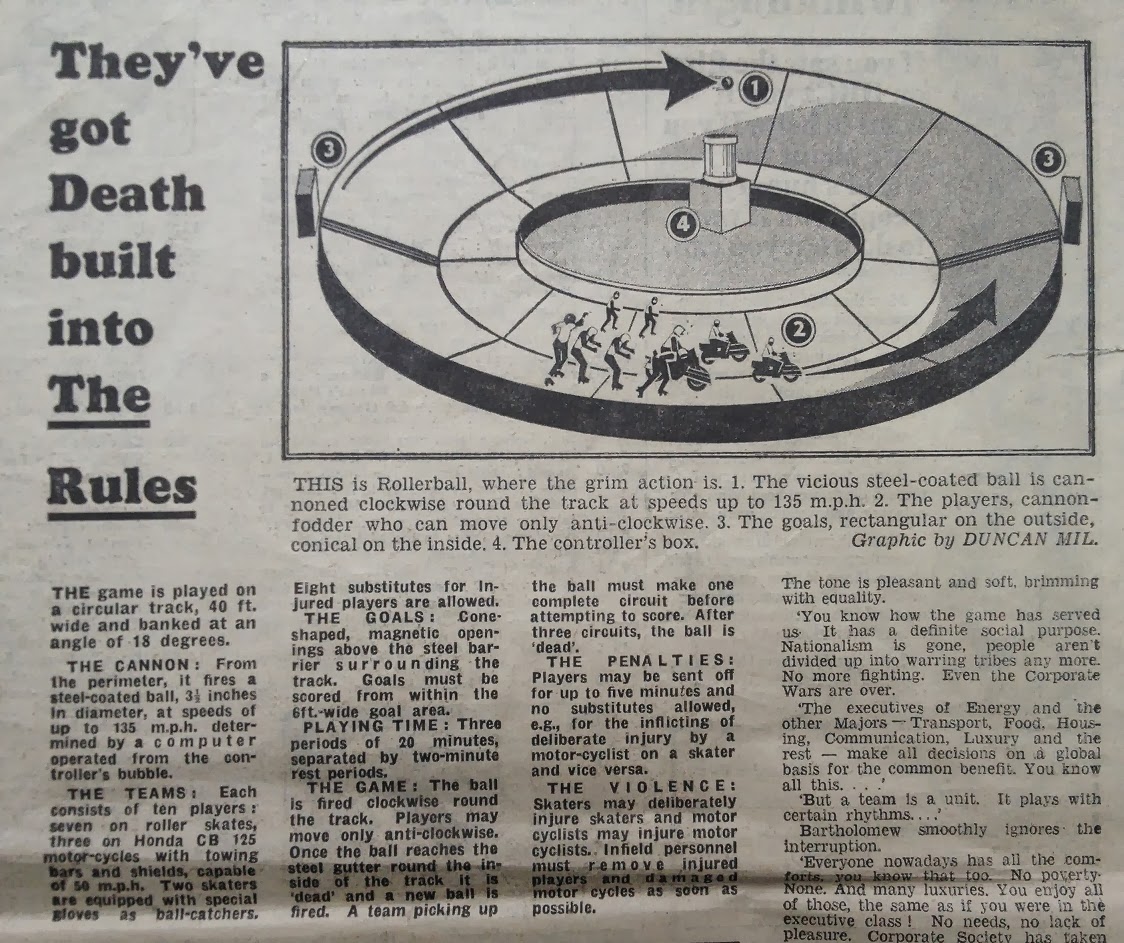
Staged on an Olympic German arena that doubles (triples?) for all three stadiums in the film, the skating skills of the cast and stunt performers are superb. Each game packs more excitement than the whole of the 2002 remake. The publicity also concentrated on the game, even the rules appeared in newspapers (though this may also have been because they weren't very well explained at length in the film).


Daily Mail, September 1975 - how to play Rollerball
The two teams have to fight for ownership of a steel ball (fired at a high speed onto the arena). The player with the ball has to complete a circuit of the arena before landing it an electromagnetic goal. The players are all on rollerskates except for the motorbike riders. They're allowed to punch and kick the opposition to gain possession of the ball. If it hits the floor, it's out of play.


Daily Mail, September 8th, 1975
I'm guessing the Daily Mail complained about the film, as well as Death Race 2000 and The Sweeney on TV as examples (and causes) of an increasingly violent society. However, the paper also publicised the film with three days of double-page centrespreads (the first is above) telling the story of the film, in the lead-up to its London premiere. 


James Caan looks great on skates and a totally convincing champion of the world. But he never convinces that he could evade and outwit everything that the corporations could throw at him, when he starts to disobey. As I mentioned, Caan isn't keen to say his dialogue clearly, in stark contrast to John Houseman who appears to be over-enunciating, especially the name "Jonathan E", in an attempt to improve Caan's diction by osmosis.


Co-star Maud Adams (above) had just been a Bond Girl in The Man with The Golden Gun. Jonathan E's easygoing sidekick on his Houston team is played by John Beck, who at the time seemed destined for leading roles and stardom, but after Sky RidersThe Big Bus and Audrey Rose he was soon back to TV. 

The cinematography is clinical but covers the action impressively and there's a great use of the futuristic architecture around Munich, Germany, including the multi-cylindrical BMW building that also appears in the middle of Suspiria.


William Harrison expanded his original short story, The Rollerball Murders, into the script. What happened to it then was up to director Norman Jewison (and apparently Caan). Shame that Harrison didn't then novelise his ideas for this expanded scenario of his script. The above tie-in only contains the original short story. Though he eventually published a set of essays about his life and work in 2010 - The Rollerball Mutations. While writing this, I've learned that Harrison recently passed away, in October.

Films Illustrated advert - March, 1976
Reading through old movie magazines, the exact timing of Rollerball's release in the UK threw up a mystery. The Daily Mail and Photoplay coverage support that it premiered in London in September, 1975. But the above advert for a wider release is from March, 1976. Did Rollerball run in the West End for six months before going on general release? That's unusual. It certainly means that it was popular and made money. It was repeatedly re-released over the next few years, once on a double-bill with Death Race 2000 (below) and I saw it again when it was paired less obviously with Juggernaut


The key art for the Rollerball poster (at the very top) was instantly an iconic image. It was painted by Bob Peak, responsible for many other beautiful posters for great films... More examples of the poster art of Bob Peak here on Steve Lensman's site.


Rollerball is on DVD in a special edition with commentary by director Norman Jewison, pointing out how many of his predictions have since come true. The cinematography alone deserves blu-ray treatment, besides the film's cult status.