Thursday, 6 June 2013

WOODSTOCK (1970) - they look just like us


WOODSTOCK
(1970, USA)

Epic documentary about a massively positive moment

After hearing from director Michael Wadleigh at the recent Wolfen screening, (my full report here), it seemed foolish not to watch Woodstock, still not knowing quite what to expect. I like a lot of 1960s music, but more Motown and British pop than the rock and country acts at this festival. But it turns out to be much more than just the music...

After years of trawling through record shops, Woodstock album cover had put me off seeing the film. A blurry photo of a crowd standing in a field, not very cinematic and totally misleading. I was honestly expecting grainy, badly-shot 16mm footage, judging from the cover.


My first-time watch was the remastered Director's Cut, expanded from roughly three to four hours, and it flew by. It describes the event from start to finish, as it nearly becomes a human disaster when half a million people turn up, blocking all roads entering the area, and spreading out over the neighbouring fields. Besides finding tons of extra food for everyone, how can the bands get there if all the roads are blocked?

I found this all fascinating because the focus is just as much on the audience, the organisers and the local reaction to the event. Woodstock is about like-minded people getting together and discovering just how many others there are like them. It's about an open air concert besieged by thunderstorms. And how to police a small city that sprang up overnight.

The attitudes of the time are partly conveyed by the performers and organisers interacting with the crowd. No-one's making speeches, but lyrics and throwaway comments illustrate the openness to recreational drugs, a distrust of the police and anger at the Vietnam War and the resulting compulsory draft (every month, over 30,000 young men were called up to serve in the US Army).

The hippie stereotype is constantly corrected. There's longer hair, but very few people have the 'John Lennon' straight hair, which takes a lot of effort. Not many have sunglasses, rose-tinted or otherwise - they were expensive. There's as many clean-shaven guys as those with beards or taches. Like any crowd, it's simply not definable. It's a cross-section of young people of the time, attending for the music and the vibe. There's no uniform. The current shorthand of the hippy 'look' is an amalgam of what the superstars wore, not the crowd: Janis Joplin's little round sunglasses, Jimi Hendrix's waistcoat and bandana, Jerry Garcia's fabulous furry facial hair... Admittedly, this is how the director still dresses.
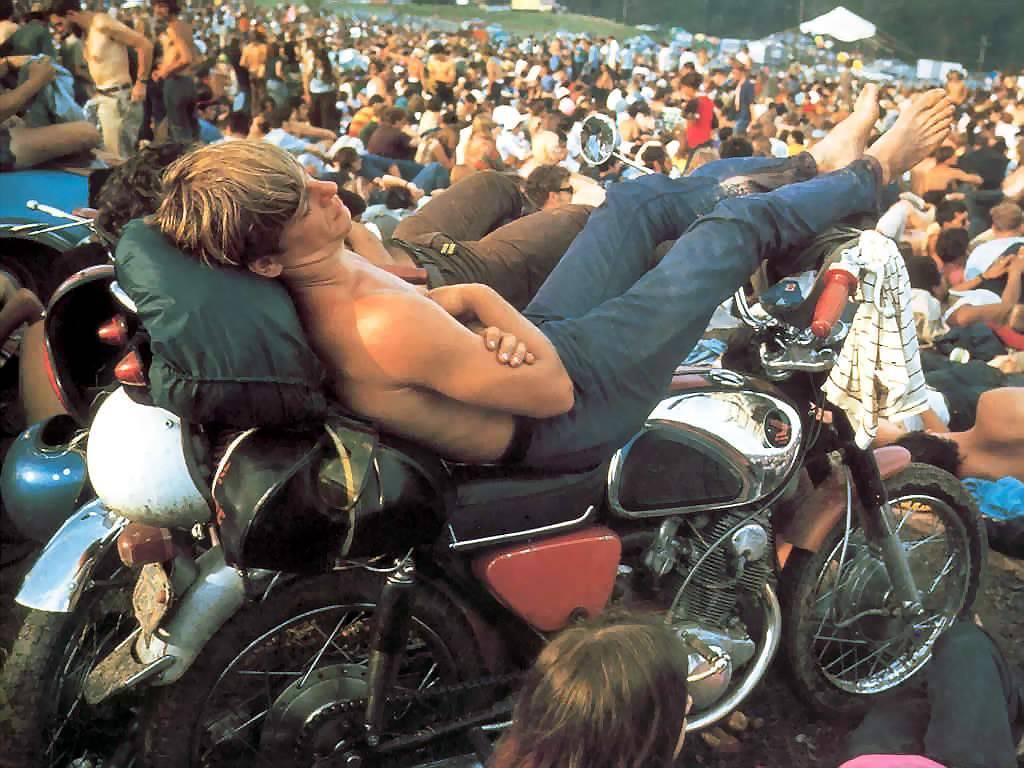

The activities among the audience include throwing off many of society's restrictions. Spontaneous nudity and skinny-dipping, open air love-making, legal highs, yoga... Notably, amongst the thousands of teenagers and twenty-somethings, very few are overweight and no-one obese. If anything, they're an exceptionally fit-looking crowd compared to nowadays.

I was also expecting a shambolic event, which it might have been by today's standards, partially because the numbers that turned up far exceeded expectations. But while organiser Mike Lang looks like a member of The Warriors, he's quietly keeping the whole show going, riding around the huge site on his motorbike. While unexpectedly popular, it wasn't a spontaneous 'happening' - it was a carefully planned concert. There are medical facilities and portaloos, just like today. Not even a storm blowing through (a dramatic scene) can stop the music for long.

It's an amazing crowd doing amazing things. I found the overwhelming, positive feeling from the event very uplifting. The organiser's attitude to money, declaring it all a free concert, happy that it's such a great happening, oblivious that it'll him lose millions of dollars, is a wonderful thing to see. A seismic shift from the usual view of the world.


Music-wise, I most enjoyed Sly and the Family Stone and the effortless, amazing guitar work of Jimi Hendrix. The energy of the first performer onscreen, Richie Havens, attacking his guitar, further demonstrates how unique many of these musicans still are. I was saddened to learn that he'd only just passed away in April. Havens' recent death contrasts with the performers who famously passed away the year after the concert, notably Janis Joplin and Jimi Hendrix, both at the age of 27.

Between songs, and often seen simultaneously in a split screen, the rest of the event is documented. The helpfulness of local people and organisations in making it all happen. The interviews with local farmers, some for, some against. But a heartening support from some parents, some adults against the Vietnam war - proving that the kids weren't alone in their attitudes to war and peace. Even the local Chief of Police is happy with the good behaviour of such a huge crowd.


I'm sure it's not a totally balanced view, but the film doesn't shirk from the downsides - the dangers of drug use (there was an overdose fatality at the event), a woman freaking out because of the size of the crowd, the logistical problems as the huge event spreads out into neighbouring properties... I'm going to read more about it all in The Road To Woodstock and plough through the special edition extras, intrigued about everything that happened and how it all happened.


Screengrab: organiser Mike Lang interview / chaos on the roads
Defying my expectations, the blu-ray has great image quality. It was actually shot on 16mm, but by a squad of professional cinematographers, and then blown up onto 70mm negative! The amazing editing and splitscreen presentation, spread across the 2.35 frame, makes this a great cinematic experience. Sometimes a central 1.85 image, sometimes two, showing an interviewee on one side and what they're talking about on the other. A triple split with three angles of a performance onstage - most impressively realised when the images overlap and blend. Among the assistant directors and editors are one Martin Scorsese and Thelma Schoonmaker (she later edited Raging Bull, Casino and many more).


My first ever watch was with this four-hour Director's Cut, though I didn't notice any padding, or differences in quality that gave away what was new. The Jefferson Airplane performance is part of the new footage included and it was great to hear singer Grace Slick in action. This Ultimate Collector's Edition blu-ray also includes a second disc with three hours of background documentaries and excised performances.


It's a testament to Michael Wadleigh and his crew, enduring a very difficult shoot (communication with the outside world was impossible for much of the event). The resulting quality is so good that it looks as if it was shot last week. If only it had been. I wish the optimistic, free-thinking, positive action, anti-war vibe was this strong today.


See also, my report on director Michael Wadleigh attending a screening of Wolfen.


Saturday, 1 June 2013

From WOODSTOCK to WOLFEN - the director Michael Wadleigh


A recent screening of WOLFEN (1981), introduced by the director

Wolfen is an extraordinary film that shouldn't have been sold as a werewolf whodunnit. Caught inbetween the releases of The Howling and An American Werewolf in London in 1981, I guess it was easier to go with the flow than attempt to ready audiences for a thoughtful, high-quality thriller.


Thirty years ago, it wasn't the horror film that I was expecting, but the performances and locations stuck with me, and warranted many revisits. Now came a chance to see it again on 35mm film. 


The Cigarette Burns event, at North London's Phoenix Cinema on May 3rd, gave us the opportunity with a very special bonus, the director was there to introduce the screening, watch it with us and answer questions afterwards. Though he was polite about sticking to the event's of talking about Wolfen, we were also keen to hear him talk about his previous, more famous document, Woodstock.


Wadleigh looked as if he'd just arrived from the Woodstock festival. But talking about Wolfen, made in the early 80s, convinced us that he'd remained as passionate about this very different project, injecting a consistent worldview into it. But he's also very aware of what audiences expect from a bloody, good thriller! 

Before the film rolled, he gave us some key insights. The decimated neighbourhood of the South Bronx was one of several key New York locations he wanted to show, illustrating the chasm between rich and poor neighbourhoods.


The opening scene of the windmill in Battery Park was much more than just a visual device, but a symbol of the early Dutch settlers, some of the European immigrants that cleared out the area's Native Americans. Some of the pioneers ended up as owners of multinational corporations, their headquarters standing only a few blocks away in Manhattan's financial district. These pertinent locations provide cinematic visuals, layers of subtext and a spectacular document of a recent time that now looks very different.


Wadleigh picked the cast of Wolfen based on their theatre experience, as opposed to any filmography. Luckily, Finney had both. Hardly bankable at the time but he was just starting a short roll in Hollywood.


I'd no idea that they'd filmed real corpses in the autopsy scene. The attendant talking to a corpse really worked there, and that's how he worked. One of several examples of the director using real people as themselves throughout the film. It was also realistic for the bodies to be laid out naked, without sheets over them.


The use of the gliding portable Steadicam camera mount in many scenes, worked exceptionally well. Inventor Garrett Brown was operating it and felt that he'd best achieved a point-of-view shot with his work on the film. It was certainly a fresh and thrilling experience to watch when it was first released, pulling you down to the Wolfen's rapid, roaming, low perspective. Whereas his work in The Shining was a detached 'eye of God', here he made the camera act like a beast, ducking around corners and hiding until it was safe to emerge.


We settled in for the screening, the atmosphere primed by Wadleigh's large dog also settling in the front row. The print was in good shape, which was good for us, but a bad sign that it hadn't been watched very much!


I've already talked about the story of Wolfen here, after watching it on DVD four years ago. But seeing any film in a cinema is an opportunity to concentrate on the story and drink in all the visual detail without any distraction. I finally followed the whole story, rather than waiting for the next piece of action, particularly the arc of the police investigation and its awkward interjection at the climax.


Because a powerful millionaire (and potential presidential candidate) has been murdered, the investigation is of the highest level possible. We see the use of illegal, experimental, scientific monitoring of suspects' interrogations, like invisible lie-detectors. The investigation has access to omnipresent surveillance, and an overriding control of the flow of news to the media, as well as a paranoia about it being a terrorist attack. With references to recent 'explosions' (I'm not sure what incidents they mean), it's all a reminder that terrorist attacks were nothing new thirty years ago.


After the screening, despite being well after 1am, Wadleigh indulged us in a lengthy Q and A session hosted by Josh, Mr Cigarette Burns himself, who'd had a long day and his mind blown by an earlier dinner with Wadleigh and his partner.


I was amazed that his Woodstock-era convictions were as strong as ever. Wadleigh is still figuring out he can save the planet from ecological doom. A positive, can-do, approach to a huge complex problem, fuelled by the foresight of what the endgame could be. As he put it, the planet ending like in a bad disaster movie.

He talked a little about making the documentary movie of Woodstock and how, even in 1969, the organisers had to resist corporate sponsorship wanting to exploit the event. He also applauded the current organisers of Glastonbury from resisting similar temptation. I'd no idea that Wadleigh now lives in England.


He admitted that he'd put many of his ideas into Wolfen, discarding much of Whitley Strieber's book, for which he later personally apologised to the author. But hearing where he's always been coming from made the links between the Woodstock and Wolfen worldviews stronger. Watching Woodstock beforehand helps solve Wolfen's mysteries.


While the high-tech system investigates, Finney's renegade character arrives at the truth. helped by several other individuals with wild ideas and counter-culture attitudes, like those played by Gregory Hines (Running Scared, Eve of Destruction) and Tom Noonan (Manhunter, The Monster Squad).


I was dismayed to hear that the iconic church at the centre of the desolate Bronx landscape was in fact a huge outdoor set, one of the largest ever built at that time. We also heard about the amazing scene where Albert Finney and Edward James Olmos clamber about on top of a Manhattan bridge without any safety wires. He applauded Finney's professionalism at agreeing to do it. Especially tough because it was very windy that day...


We were told how the original soundtrack composer had been replaced by James Horner, who already sounded like he was warming up to scoring Aliens, but that was a great decision that works for the film.

Also, Wolfen was recut for its release, shortened without the director's input. While it had been financed as a major film, even hoped to be an Oscar-winning 'message' project, the studio had lost confidence and releasing it under the werewolf angle. Such as a standard horror movie poster of a wolf with fangs dripping blood...

The DVD release has lost a further scene where Tom Waits sings in a tiny dive bar. Wadleigh said that he was also already friends with Edward James Olmos, who he'd seen perform as lead singer (with his rock band 'Pacific', the biggest thing on the West coast!).


After Wolfen, Wadleigh continued to play the Hollywood game for many years, with three more of his original scripts very nearly getting made. Instead, he's made more documentaries about the Woodstock era.


He was under no illusions that movies could make a huge difference in people's opinions, and regarded them basically as entertainment. Now, in an attempt to save the planet from climatic disaster, he runs lecture tours, talking to and with scientists, the people who have the data about what's happening to the climate, about how they might better persuade us all of the course of action that could save the planet.

Wadleigh's energy and motivation made me miss the optimism and problem-solving practicality of the hippy generation. So few people talk like this, it was inspirational to hear him.

So it was disappointing that more people hadn't come to see this and to meet him. He described Wolfen as a forgotten film, which is tough to hear about something I rate, but it appears he was very right!

Seeing this and The Keep screenings, have reminded me how much more I prefer the experience of film on 35mm, as well as the atmosphere of a midnight movie... at midnight.


Catch the latest screenings of films on film, at Cigarette Burns website, Facebook page or Twitter feed.


Great collection of Wolfen posters and promotional photos, here on The Wrong Side Of The Art.


My previous, illustrated preview of Wolfen is here.


Next up, I watch Woodstock for the first time...


Wednesday, 15 May 2013

LASERIUM (1977-1990) - Londoners' opportunity to stare at lasers


In the 1970s, what were the alternatives to going to the cinema or the pub? Well, one evening went to the London Planetarium, listened to loud prog rock and watched lasers!

I've been struggling to remember my visit. But at the time I associated lasers with sci-fi weaponry, most famously as a powerful cutting tool, as in Goldfinger's attempt to make James Bond go in separate ways. I'd not been to any rock concerts at this point, so hadn't seen any lasers in action. I went with several friends, half expecting to die by decapitation because I was the tallest.


The Planetarium, recognisable by the green dome, was an adjoining attraction to Madame Tussauds (the building is still there). The comfy, padded chairs inside were arranged in circles, tilted back to face you towards the hemispherical ceiling. With the lights dimmed, a complex projector emulated scientifically-accurate views of star constellations and planets.


But the science stuff was for the daytime, in the evening they showed Laserium instead! We sat in the same seats, but while they cranked up an eclectic playlist of psychedelic rock, the operators shone brightly-coloured holographic laser-shapes over our heads (we might even have had protective glasses on). I believe each show was different, the show wasn't pre-programmed, the operators 'played' the lasers live!


On offer were two different programmes of music, called Laserium and Laserock. This programme that I bought on the day (shown at top), lists the default playlists of music they used.


The thin blue 'membrane' that floats over the egg chamber in Alien (1979), is the vivid memory I have of an actual laser used in a movie, but a couple of years later I remember them being used in nightclubs, shooting into the eyes of the crowd indiscriminately (we still didn't know if that was safe or not). They also cropped up in a heap of early 80s pop videos, like the refilmed version of 'Relax' by Frankie Goes To Hollywood.

Lasers continued to be cool all decade, and the London Laserium attraction lasted until 1990 - no doubt with a few changes to the playlists.


The American Laserium experience - a website for the uses of Laserium technology in the USA.

The Australian Laserium Facebook page - a nostalgic take with more photos.


Here's an amusing radio advert for the London Laserium, circa 1979 when I caught  the show. This depends mainly on users comments making vaguely trippy references and calling it "indescribable"! On the day, I was disappointed that the backing music for the advert (Vangelis - 'Pulstar') wasn't part of the show...


Monday, 13 May 2013

Drive


Drive came out in September of 2011 but sadly I was never able to see the movie at the theaters. I think the first time I was able to see it was on dvd when I rented it from my library job, yes they do have some good dvd and now bluray choices at the library now a days. I recall my brother really liked the movie, I even bought him the bluray for his birthday last year.


Drive is a movie that some might not get or like and I can somewhat understand while they would have some minor gripes but for me Drive is slowly becoming a modern day favorite of mine. I have seen the movie two times now and the second go around was just as enthralling as the first time I saw the movie. Drive is a crime movie a romance movie and a heist movie all rolled into one amazing movie. The actors are all top notch, so many good performances from Ryan Gosling, Albert Brooks, and Bryan Cranston (to name a few).


The movie just is flat out cool. It has a retro 80's vibe to it but the movie isn't trying hard to look like it was from the 80's. I think a lot of it has to do with small choices the director Nicolas Winding Refn made. The first heist scene really gets the movie started with a bang. The movie features some amazing stunt work and all without CGI stuff you get in most movies today. Gosling kills it as Driver (he is never named) a true hero who steps up to help the people he cares about.


The music of Drive blew me away. Just last night I couldn't get A Real Hero by College out of my head and decided to buy the entire album which has a great mix of songs and score. The music really just makes the movie all the more better, I love the choices they made with the music.


To me when a movie makes me think that was cool is sort of rare today. Drive is a movie what I would consider cool and has a very unique style to it, a style I do not see in most cinema today. Gosling and Refn will be teaming up again for Only God Forgives which should be released this year. I cannot wait to see what they do next.


If you haven't seen Drive I suggest you get and do so!

(I am posting some of the posters this movie has inspired  glad to see that many other people have enjoyed this movie and it moved them to create this art)


Tuesday, 7 May 2013

THE UNINVITED (1944) - UK special edition DVD


THE UNINVITED
(1944, USA)

Slick mainstream chiller with a light touch but serious ghosts

The Uninvited is an early example of a movie where haunting is taken seriously and investigated as a phenomenon, setting up many of the key traits of every ghost hunt ever since. The haunting is linked to location, its arrival heralded with a temperature drop and even a scent, it scares animals and possesses the living...

So many silent 'haunted house' movies of the 1920s reveal their spooks as human mischief in the last reel. Decades before before the tradition of Scooby-Doo, last-minute unveilings of wires, mirrors and masks, filmmakers portrayed spiritualists and ghosthunters as frauds and/or for laughs. There were many real-life mediums and spiritualists in work after the massive, incomprehensible losses of life during the first World War, but I'm guessing that as the decade wore on, scepticism replaced the belief that the afterlife was contactable.

Monsters, rather than ghosts, were more popular as supernatural beings at the start of the 1930s. But after the second World War began in 1939, it's no coincidence that ghost movies returned and, this time around, audiences were ready to believe. Again, a yearning that it was possible to contact loved ones who'd passed, and that death wasn't the end, especially for those who'd died young.

I'm thinking of the wartime British ghost stories that are more drama than horror, such as Thunder Rock (1942) and The Halfway House (1944). Then Dead of Night (1945) went for the throat with a clutch of stories so chilling that they still unsettle us today. In those films, the ghosts don't turn out to be faked, but neither are they particularly ethereal. They appear to be physical beings.

Similarly, in the US, there were ghosts in films before The Uninvited, like Topper and Topper Returns. But those ghosts are primarily a comedy device, also portrayed as very physical and non-transparent people. Added to this, the central character is unafraid of the phantoms. These comedies still have their eerie moments (like the murder in Topper Returns). See also Blithe Spirit (1945), the Noel Coward comedy where Rex Harrison is again plagued by his first wife, inadvertently called back during a seance.


Watching The Uninvited again after a long break, I was very taken by its modern approach to portraying ghosts as a series of phenomena, with characters who waste little time in taking it seriously, while being aware of the danger. Of course, this may not be a case of a film being ahead of its time, but rather one that is hugely influential. Guillermo Del Toro even rates it as one of his favourite fright movies.

It's also interesting to see that The Uninvited is very much an 'A' list picture, pitched as a follow-up to Rebecca (1940)! That is, a dark drama with a young woman trapped by the lure of an old house. It even strongly hints that one character is a lesbian, even less subtly than Hitchcock outed Mrs Danvers. For 1944, the backstory is remarkably rich with stuff that couldn't be shown in those censored times.

Oh yes, the story. Ray Milland and Ruth Hussey play a brother and sister who stumble upon a solitary, clifftop house on the Cornish coast of England. Falling in love with it, they buy up and move in, only to discover a series of mysteries. Their pet dog refuses to go upstairs, there's a damp inexplicably cold studio up there and... noises in the night.

Once they realise that the sobbing in the night has no earthly cause, they soberly adjust to the idea that it can only be a ghost. They logically analyse the clues and psychological effects of the house to discover who it might have been. Meanwhile, Ray is getting involved with the young woman (Gail Russell) who grew up in the old house, though her father (Donald Crisp) forbids her to return to it...


Throughout it, I was thinking of Poltergeist, the long winding staircase leading up to trouble, the billowing ghost, and elements of the story, like the young woman caught in a tug of war between this world and the next... Maybe an unfair comparison to tease you with, because The Uninvited is more like a Thin Man mystery, with ghosts instead of criminals. It's not a bonanza of visual effects, but there are more on display than in, say, The Haunting or The Innocents.


Mistakenly, I started off convinced that this was actually a British film. The attention to detail and authentic accents puts the rest of Hollywood history to shame in its depiction of a small village in England. An RAC logo, signs for British beers in the pub windows, country lanes... all very convincing, but made in L.A.!


The cast are likeable, believable, though still playing it all with a dose of comedy and romance for a mainstream audience. Impressively, Ray Milland scored best actor Oscar with his portrayal of an alcoholic hitting rock-bottom, the following year with The Lost Weekend. Here's an actor on the top of his game.

Lovely to see Alan Napier getting a decent role, decades before achieving immortality as (Adam West) Batman's butler on TV.


I first knew of it as one of William K Everson's Classics of the Horror Film, who devoted a chapter to it with Dead of Night. It's about time it hit DVD in the UK. Exposure Cinema's region 2 release includes radio re-enactmants, an original trailer and a thick booklet filled with glossy reproductions of poster art, lobby cards, and essays on the film and its stars.

Moviemail have it on sale, with an informative page and some original publicity photos.


Monday, 22 April 2013

6/11/93


I can still somewhat recall the events of me seeing Jurassic Park for the first time one June 11, 1993. I was 13 at the time, and in 7 days it would be my birthday. My brother took me as a birthday present to see the movie at the Century 21 theater in San Jose. This was back before I could find out all I wanted to know about the movie by hopping on the internet, so all I knew is what I saw from commercials on TV, movie previews, or magazines including comic book advertisements. I remember that they wouldn't show the entire dinosaurs head in any print or commercials because they wanted to keep it a secret, something I am not sure you could get away with in todays show me everything now media. So going in all I knew that is the next big thing from Steven Spielberg and that it had dinosaurs, who I had yet to see an entire one of. Spielberg was coming off of Hook, a movie that was pretty much a big disappointment in 1991 even though it had found a cult following with people around my age.


In fact my wife just bought it. Here is that story: It was buy one get one 50% off at Toys R Us. They had a great deal on Close Encounters of the Third Kind on bluray for only $9.99! This is the 3 disc edition version. So we looked for another bluray that we could get and I didn't see anything I wanted but my wife wanted Hook, fair enough as it completes a Spielberg double feature and is a movie that appeals to kids and adults, well mostly kids. It was the same price as the Close Encounters so it all worked out. I took the movies up to the guy who was working the movies/video game section to buy. He said he didn't even know they had Close Encounters on bluray for so cheap. I was thinking I must look pretty smart to this 20 year old guy working at TRU! But then he saw the second movie and he just had to give his two cents on a movie I was actually buying from him! He pretty much went onto say that it was one of the worst movies ever made, up there with the Super Mario Brothers movie in the pantheon of shitty movies. I started feeling bad for Hook now, OK, it is not the best movie ever made but come on! This is not Super Mario Brothers bad! I mean you have Ruffio for fucks sake! Anyway I still bought the movie, it was after all 50% off.


So I was saying Jurassic Park was big return to what Spielberg could do well, an action adventure movies with frickin dinosaurs! The Century 21 was a once screen theater and from what I was told has one of the biggest single screens in all of the bay area. People would often camp out and wait in line for hours. It was something people used to do more before all the midnight screenings and online tickets, and I miss some of that. We waited in line for what seemed like days, mind you we couldn't just pull out a smart phone but had to talk or read a newspaper or magazine. I even remember the friend who I decided to take bought me a soda waiting in the line as an early birthday present (not the worst bday gift I ever got!). Finally we got to go inside...


As for the movie, well what I can recall was how loud it was. For some reason they sound seem to be extra awesome for Jurassic Park. They had the digital sound and I recall the seats shaking when the T-Rex roared, it was just so cool. The movie was just a perfect blend of special effects and practical effects, showing that CGI was the wave of the future that it has now become. It was just a pure exciting thrill ride of a movie, one that you get out of and want to go right back inside and watch again. I do not remember a lot of movie experiences as well as I remember the time I saw Jurassic Park for the first time, I guess it just goes to show you how special it was to me. And the following Monday me, my brother, and my dad all went to the Century 21 to see it again. The movie was just as amazing on that Monday as it was a few days ago on that Friday. I believe I went onto see the movie 2-3 more times in the movie theater altogether


I recently saw the Jurassic Park in IMAX 3D and I am happy to say it play just as well now as it did those twenty (wow) years ago. The 3D is actually very well done for an older movie and really does add to the overall experience of the movie, something that most 3D is lacking in todays market. I was happy to see that Jurassic Park is one of those films that will forever be a fun thrill ride (like Jaws and Raiders of the Lost Ark).  I also watched the sequels to complete the trilogy since I had them on bluray. Each sequel does get progressively worse but The Lost World: Jurassic Park does have a lot of the fun elements going for it after the half way mark it just becomes a non-stop thrill ride. The third one has a nice nod by bringing back Sam Neil (Alan Grant from the first movie) but overall the movie falls flat.


While Jurassic Park is not a classic movie it is one of those movies that I will easily be able to watch over and over again and one day share with my children. I will always remember the experience of seeing the movie and all the things that went on that day twenty years ago in June.


Sunday, 21 April 2013

SAMSARA (2009) - worthy of BARAKA and KOYAANISQATSI


SAMSARA
(2012, USA)

Another astonishing 'non-narrative movie' from Ron Fricke

If you've seen Baraka (1992) or Koyaanisqatsi (1983), my job of describing Samsara to you would be much easier.

Most of what I know about these amazing films is from DVD extras and the issues of American Cinematographer that covered them. Officially, Ron Fricke was the cameraman on Koyaanisqatsi which was directed by Godfrey Reggio. In reality it was an experimental collaboration between them. Reggio wanting to communicate just through images and Fricke's eye for the amazing, combined with his innovative use and development of mobile time-lapse cinematography. Koyaanisqatsi shows us the incredible. Together with the hypnotic effects of Philip Glass's soundtrack (which also interacted with the editing and structure of the scenes), it also inspires a contemplation of, well, life on this planet.


Fricke hasn't collaborated with Reggio since, but both continues to direct similar 'non-narrative' movies and short films ever since. Reggio with two more 'Qatsis', Powaqqatsi looking more at the people around the world, Naqoyqatsi at our digital future. Fricke most notably made the epic Baraka - a glorious look at the natural world.


But neither man has since achieved the same hard look at the world as Koyaanisqatsi. Though Samsara comes close by including themes of industry, colossal scales of waste and even disposable people - androids. As well as the astonishing use of Fricke's trademark motion-control timelapse camerawork, but this time for night-time scenes, with stars revolving in the sky and statues lit only by moonlight.


The mix of natural wonder and the never-ending consumption of complex manufactured goods, not to mention animal products, makes for many memorable points without using sledgehammer tactics. The camera stands back, without pointed close-ups, allowing the viewer to pick out their own details. Fricke continues to include his slow-motion 'portraits' of people and couples from around the world. Most touchingly in the section on the aftermath of Hurricane Katrina.

Samsara prompts us to think about many different aspects of the world, I've not mentioned them all, and very different trains of thought to those triggered by advertising, random TV or a YouTube homepage.


It's like drifting around the world in a balloon with a telescope. A mystery tour of amazing places I never knew existed. Like Koyaanisqatsi, the point isn't to constantly pinpoint where and what you're seeing, but to watch what's happening. 


Afterwards, the making-of documentary can tell the story of the five years of collecting amazing footage on huge 65mm cameras, around 25 different countries, in some inaccessible locations and very privileged vantage points. Many directors spend extra effort on their establishing or opening scenes. Samsara feels like a feature compilation made up of those.


This amazing shot of a temple reveals dozens of others in a surreal, smooth, vertical reveal, presumably filmed from a balloon. The number of temples sitting so closely together in a lush green setting honestly looked too good to be true. We needed to double-check our eyes for CG trickery. But that's not how these films are made.

Samsara is further guided by its imagery by being edited without any reference to music. Where Koyaanisqatsi was partly cut to music, Samsara was 'silently edited', each shot allowed to run its course before giving way to the next. Only then, like standard movie-making, was a completed 'cut' given to the musicians to score.

The ethereal music for Samsara is by Michael Stearns (who composed for Fricke's Baraka and Chronos), Lisa Gerrard and Marcello De Francisci. Hearing them talk, I was touched by the fact that I'd first heard Gerrard's singing (wailing?, lamenting?) thirty years ago when she was with ambient gothic group Dead Can Dance. It was like reuniting with an old friend!


Samsara deserves seeing on as big a screen as possible, showing in most theatres on 4k digital. Blu-ray is obviously the next avenue you should explore. The blu-ray image is of course 1080 by 1920, the '8K' referenced on the cover is the resolution width that the film was originally scanned at. 

Also, don't be put off by this being exiled to the documentary section. There's no voice-over, no talking heads. It's in a genre all of its own.


A thorough interview with Ron Fricke and co-writer/producer Mark Magidson about their adventures making Samsara, here on Horror Cult Films.