Showing posts with label 1960s. Show all posts

Friday, 27 September 2013

Filming Location: THE INNOCENTS (1961) - not far from HELL HOUSE!


Yesterday, we went to look at the main location used for The Legend of Hell House. As it's only a few miles away from another famous horror film location, we did two locations in one trip. Again, Derek Pykett's guidebook, British Horror Film Locations, points to where the exteriors for Jack Clayton's The Innocents were filmed, over fifty years ago. Deborah Kerr starred in this classic, layered ghost story, enormously enhanced by cinematographer Freddie Francis. It's deservedly been restored and released on blu-ray by the BFI.


But once again, there are no more details in the guidebook. We'd no clues how to find specific scenes and camera angles. Like many movie location guides, an address is only the beginning of some amateur, nerdy detective work. 

As usual, I'd prepared badly and not seen the film recently. Instead I'd found some key screengrabs online of scenes that looked like they might still be recognisable (visible parts of buildings or landscape that might still exist) and in particular the haunting shot of the shadowy figure in the reeds - a shot that really frightened me and I've always wanted to see for real. Easier said than done...

The exteriors of The Innocents were shot at Sheffield Park and Garden, a huge National Trust site nowhere near Sheffield! It's actually in East Sussex just off the A23, a few miles outside of Brighton, and only a few miles east of 'Hell House'. 


Sheffield Park Hall


Like the Hell House location, this mansion is now a private residence, but there's a great view of the front from inside Sheffield Park Garden. Near the entrance to the garden (there's an admission fee of £8.50 unless you're a National Trust or Royal Horticultural Society member) is the best view that the public can get of this huge house. 


But looking at online photos of the house, the terrace - where key scenes of the story take place - appears to be a studio set (or a different location?). From other photos online, and the aerial views, there doesn't appear to be a paved terrace on either side of the mansion. Not any more, anyway.


Looking closer, I was keen to find this turret, where the shadow of Quint appears. But compared to this screengrab, the stonework matches but I couldn't find a close match - again this could have been faked (perhaps the corner has been faked with a matte painting?).


I took these two close-ups to try and find a match for that turret, but there's apparently no corner like it. 


Sheffield Park Garden


We had more luck as we walked round the gardens, and the staff also gave us some useful pointers as to where to look. Sheffield Park is huge, but the carefully landscaped garden is a manageable stroll.
The house can be seen, on this aerial view from Google Maps, at top left (with the circular drive above it). The garden entrance is just below the main house. The ornamental gardens enclose four huge artificially-made ponds, each constructed at a different water level, a cascade feature leading from one pond to another, each cascade with an ornamental bridge. 


The first bridge is where you get this grand view of the mansion looking across 'Ten Foot Pond'.


Here's a photo of the high side of the first bridge, also called Top Bridge. Note that it's made entirely of stonework...


The missing gazebo!  


The gazebo (at right) was probably only put there for the film but, incredibly, there are still palm trees (behind Deborah Kerr, far left) at a similar spot in the gardens.


On the lower side of the stone 'Top Bridge' is Pelham Falls, usually a grand water feature, but not operational on this day. But here too are two palm trees, on the right. We took another shot (below) from the clearing seen (above) on the left.


At the base of Pelham Falls - this angle is taken from the grass clearing to the left of the stone bridge. The grass slopes down steeply towards the water, matching the high camera angle in the gazebo shot. I believe this clearing is where they shot that gazebo scene, with those palm trees in the background.


Spooky bridge


A distant figure, dressed in black, standing amongst the reeds. This was the scene I really wanted to find. But water, reeds and trees can change totally over fifty years. The only real clue was that bridge... 

This was the toughest, but most satisfying find of the day, but only when I got home and looked at all our photos again! I'd used this screengrab (above), viewed on an iPhone, to guide me to find this specific angle of a bridge. But in Sheffield Garden there are three bridges to investigate, each could have been filmed from either side...

Assuming that that bridge hadn't been completely rebuilt since 1961, which is a fairly big assumption, Top Bridge was first eliminated because it was made of stone and didn't have iron work railings.


This second bridge, referred to as Middle Bridge, has iron railings. It joins Middle Lake to the huge, split 'Woman's Way' pond at the east of the garden. 


I shot the Middle Bridge from both sides, note the drop in water level on this 'backside' view (above). This was a possible match because of the size of the bridge and the background of trees. But the railing work didn't match, and the stone base of the bridge is quite flat. In the screengrab the base is arched more. It had possibly been rebuilt, but otherwise still not a definite match.


The third bridge, 'Cascade Bridge' joins Upper and Lower Woman's Way Pond (see the map). I'd decided that the shape of the bridge looked the most likely and had been shot somewhere from this side, from the west shore of Upper Woman's Way Pond, somewhere behind a small covered bench called the 'Summer House'. This theory was despite the fact that the bridge railings were vertical, whereas the screengrab shows a crossgate pattern.


I took this zoomed-in shot to try and approximate how the scene might have been framed, imagining reeds in the foreground. But, once we got home, I found that I'd got it wrong.


Here's me on Cascade Bridge, blissfully unaware that on one side there are vertical railings, but on the other side there's a cross gate pattern! I'd also not looked at the screengrab close enough. The figure in black is stood up above the water level (rather eerily), her head is level with the base of the bridge. This indicates that she was filmed from the lower pond. I think there's also a glimpse of the stone cascade to the left of the reed bed. I'd taken dozens of photos of the wrong side of the bridge!


Luckily, we'd also photographed the Lower side of Cascade Bridge. It's from the wrong angle (left, not right) but the other bank isn't accessible, and it also looks like they might have filmed it from the centre of the lake!


Therefore, I'd nominate Cascade Bridge as being in that spooky scene from The Innocents, filmed from Lower Woman's Way Pond. If you can shoot a better match, please share it with us! 

Lastly, Cascade Bridge is actually supposed to be haunted. Before the bridge was built, a headless woman was said to walk across the cascade (presumably giving the ponds the name 'Woman's Way')...


Another mystery ticked off the list, but we still haven't visited The Texas Chain Saw Massacre steak house...


Visitors' information for The National Trust site for Sheffield Park House and Garden.

Location report: The Legend of Hell House - Wykehurst Place isn't far away...

Once again, thanks to my husband, David, for the additional photography and for driving me into horror movie territory. Again. Thankfully cream teas were available and there weren't any coach parties in town.


Sunday, 18 August 2013

THE SORCERERS (1967) - a new book with the full story...


The Sorcerers (1967) is best known as the film Michael Reeves directed just before Witchfinder General (1968), and as one of Boris Karloff's last films.

Witchfinder General caused a clash with the censors, despite Reeves being friendly with the chairman of the board. The cut version was still criticised for its violence (this was before The Wild Bunch and A Clockwork Orange). It was also seen as a turning point in horror film and in British cinema, raising high hopes for Reeves' future films. But early in 1969, he accidentally died of an overdose of prescription medication.


David Pirie's excellent 1973 overview of post-war British horror films 'A Heritage of Horror' took the genre seriously and defined its auteurs, devoting a chapter to Michael Reeves. He's rightly been celebrated ever since, with several biographies of a director who only made three complete films. The brilliance of Witchfinder General compensates for the fact that The She-Beast and The Sorcerers were made on very small budgets, though all three are analysed as the body of work of an auteur.


I keep returning to The Sorcerers because it has a good cast and an intriguing story, but it's ageing badly, as was its star, Boris Karloff. Notice that the film has been demoted to DVD-R status in the USA (pictured above). But historically, The Sorcerers is important because its financial success made Witchfinder General possible. It's also a film to be studied, rather than watched. For hunting traces of future greatness from the director.

Johnny Mains' new book 'The Sorcerers' (pictured at top) aids our research with a chance to read John Burke's original script before the director rewrote it, as well as making a plain case that Burke wasn't credited accurately onscreen.

This means that 'A Heritage of Horror' unwittingly got this detail wrong and, being such a rare book on the subject, the mistake was still being repeated nearly twenty years later. For example, in the article on Witchfinder General in Cinefantastique, Aug 1991, Michael Reeves and Tom Baker are credited as writing the script for The Sorcerers, based on a novel by John Burke (the same assumption that Pirie had made). But it had never been a novel, and Burke had written much of the script, but his onscreen credit is only 'From an idea by John Burke', ('an idea' could refer to something as minor as a pub conversation).

Burke had in fact expected to be credited among the scriptwriters, just as he'd seen it printed on the front page of the shooting script. As a result, students of film would credit the ideas in Reeves' films to 'his' scripts. This error was only eventually corrected in 2003, in Benjamin Halligan's biography of Reeves.

This new book provides the proof, with reproductions of letters received by John Burke, as well as a complete reprint of his original story treatment and the version of the script before Reeves and Baker amended it. It also includes the relevant chapter of Halligan's biography to give a complete story of the making of the film.


The producers were interested in horror films made by young new talent - they'd successfully hired Roman Polanski for Repulsion. To try and focus Reeves on a possible project, he was introduced to John Burke, who had two scripts the young director was interested in.

Intriguingly, the one that didn't get made, 'The Devil's Discord', was to star Christopher Lee and Raquel Welch. When that project fell through, and Karloff agreed, Reeves reverted to Burke's other script, 'The Sorcerers'. This could actually have been a lucky break - another gothic horror with Lee could have been lost among the rest.


The Sorcerers' story was originally called 'Terror For Kicks', where a trio of scientists recruit a violent youngster to become an unwitting guinea pig for their experiment. They give him a potion that promises intoxication without a hangover. It works, but while he's under the influence, the telepathic scientists are sharing his every experience. They can also control his actions, literally living vicariously through him, without the risk of getting caught...

Script treatments can be as little as a single page, but John Burke's outline is 21 pages long. His expanded 'original story and screenplay' is 120 pages long, and even includes shot descriptions.


But Karloff wanted a more sympathetic role, so Reeves and his associate Tom Baker (not the actor) rewrote the script to accommodate him, while Burke was by then busy on a TV series. The three scientists became two, now also a husband and wife in conflict over how this new power should be used. The potion became an electronic device (a far more visual, psychedelic scene). The rewrite added more visual elements and diluted others. The level of violence and the scientists enjoying their subject having sex certainly had to be toned down to get past the censor.


Interesting to learn that Reeves' approach to The Sorcerers was influenced by another low-budget British horror that he'd seen, The Projected Man. While he was an avid moviegoer, I thought his tastes were better than that, or perhaps it was just research...

It's fascinating to see how the story evolved and how much of Burke's script made it into the final version. Besides the entire original treatment and script, there are reprints of letters received by John Burke about his fees and credit on the film, if there was any doubt about the injustice here. There's a brief word from Burke's widow, a great contextual introduction to the story by Matthew Sweet, prime trivia from Kim Newman and, touchingly, Johnny Mains' account of the discovery of the script during his friendship with the late author.

The book can be ordered here but is a limited run of 500 copies. Meanwhile, the editor is currently working on compiling the best new British horror stories of 2014! News of that can be tracked here.


(Vangelis' soundtrack to Missing and our cat Willow helped with the writing of this article. Thanks of course to Johnny Mains for giving me an advanced peek at the book.)


Thursday, 8 August 2013

Flashback 1969 - ROSEMARY'S BABY, THE WILD BUNCH, WOMEN IN LOVE...

A selection from the pages of defunct British movie magazines from 1969...
 
 
Photoplay Film Monthly, January - half page ad
This strikes me as a weird, mind-boggling double-bill. But in 1969, would have been a fun afternoon for the kids. But many mums and dads might not have been Toho Studio kaiju fans. Presumably distributors were inviting audiences to just laugh at Japanese monster movies...


Photoplay Film Monthly, January - full page ad
While the screens were quickly filling up with sex, violence and counter-culture, I was only eight, and actually found Chitty Chitty Bang Bang to be (fairly) exciting that year. It was fun to see Benny Hill on the big screen and, the Sherman Brothers' songs and Robert Helpmann's performance as the Child-Catcher have certainly haunted me ever since. The children's story was written by Ian Fleming, and produced by the same production team behind the big James Bond movies. Hence, the lavish budget and the wonderful Ken Adam sets (like the slopey-walled dungeon).


Films and Filming, March - full page ad
 
After Repulsion, Roman Polanski made another horror film set in the heart of a modern day city - this time in a Manhattan apartment block. For the time, this horror film was about as far from Edgar Allen Poe and Hammer Film gothic as you could get. Polanski had indeed just spoofed the Hammer film style with his rather odd Dance of the Vampires (aka The Fearless Vampire Killers)..


To be fair, Hammer were trying to reinvent themselves. As in, add more nudity. Not just to their vampire films, but to this follow-up to One Million Years B.C.. Despite the carnage and the cleavage, the film still only rated an 'A' certificate (kids allowed in with an adult). So, for an eight year-old, topless cavewomen and rough sex were a bit of a surprise. This would have been the film where I asked, "Mummy, what are they doing?"


Films and Filming, June - double-page centrespread
The same month, Hammer Films announced a raft of their forthcoming films. But several of the titles listed here never got made. Note that they planned another Dennis Wheatley adaption (The Haunting of Toby Jugg), that would have added to The Devil Rides Out and To The Devil A Daughter. I've seen the poster for When The World Cracked Open, but I'm not sure what The Claw and In The Sun would have been.

Films and Filming, August - half page ad
My parents didn't take me to many kiddie films, and I also saw this in 1969. The Most Dangerous Man In The World is now called by the US title The Chairman and on DVD under that name. I t features Gregory Peck and a young Zienia Merton getting tangled up in an assassination attempt on Chairman Mao! My full review here.


Photoplay Film Monthly, September - full page ad
This double-bill I also saw, but really included it here because of the supporting feature. Disney made a string of adventure films for children at this time, filmed and released in Britain and cut up to make several episodes of Walt Disney's Wonderful World of Color for American TV. Note that a teenaged Kurt Russell was already getting top billing. Diamonds on Wheels was another similar project.


Films and Filming, September - full page ad
Here's one I didn't see that year, and not for many years - until ITV first showed it as an extremely censored version. At the time, there was a furore about the amount of violence shown. I don't doubt that the Daily Mail was appalled. The film magazines were running defensive articles about increasingly violent movies (Bonnie and Clyde was another offender), while emphasising to their potential patrons just how sexy and violent certain films were.


More controversy - perhaps even more infamous than The Wild Bunch. Ken Russell's Women in Love was a very revealing benchmark of public prudity, which erupted over the scene where Alan Bates and Oliver Reed wrestled nude by an open fireplace. Not only did it break the taboo of full frontal male nudity, but their sweaty grappling was too much like gay sex for many reviewers to handle. A stark contrast to the reaction to female nudity onscreen, which had been more warmly welcomed by the establishment, although similarly carefully censored.

Films and Filming, December - full page ad

Note also, that this first played at The Prince Charles Cinema, just off Leicester Square. It's still rolling today, but with daily repertory screenings.

Next up - you guessed it - 1970!


More magazine Flashbacks:

Lawrence of Arabia and more from 1963.

Blow Up, The Trip and more from 1967.

Barbarella, Witchfinder General from 1968.


Monday, 5 August 2013

Flashback 1968 - BARBARELLA, WITCHFINDER GENERAL...


A selection from the pages of defunct British movie magazines from 1968...


Kino Weekly was a thin, fact-packed glossy trade weekly for cinema owners, enthusing over the latest movies on offer and getting them excited about what's in production. There's news of which studio or overseas location filming is happening. Sometimes films are mentioned under working titles. There are tactful guides to what's making money, premiere photos and publicity gimmicks - all great for research... This issue has Hammer Film's black comedy The Anniversary touted on the cover.

Set visit - Kino Weekly, January 6th
This photo from the filming of Witchfinder General appeared six months before the film was released in the UK.

Photoplay Film Monthly, February
An insight from Vincent Price into how he played Matthew Hopkins in Witchfinder General. Again, advanced publicity for the film.


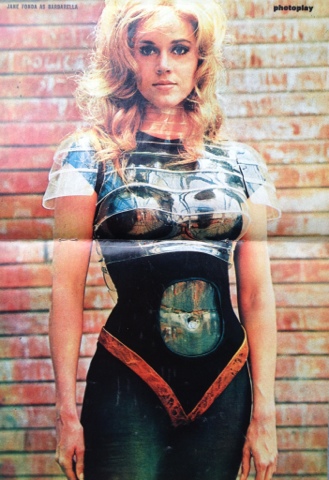
I collect magazines that feature the arrival of the movie Barbarella. So far, the best behind-the-scenes coverage I've seen are in several Playboy magazines from that year. There aren't many publicity photographs of Jane Fonda looking like a cooky sex bunny, but Photoplay found one for their cover.


Centrespread - Photoplay Film Monthly, February
Centrespread photographs of young women in 1960s editions of Photoplay Film Monthly were usually of the less well known and less dressed. This double-page of Jane Fonda is fairly restrained, but also deceptively cheeky, with it's supposedly transparent plastic 'windows'.

Photoplay Film Monthly, February
The third Harry Palmer film was also Ken Russell's first big-budget feature film. Here, the producer gets a bigger credit than Ken because of his Bond films. My review of Billion Dollar Brain is here.
 

Photoplay Film Monthly, June
An 'X' certificate for an adult drama. Very distant male nudity and the underlying gay undercurrent was presumably too much for the censor to bear. Another film that was controversial at the time, but harder to understand its screaming melodramatics now. Robert Forster (The Black Hole, Alligator) isn't mentioned in the advert, but he plays the soldier who loves naked bareback riding and attracts Brando's attention...


Films and Filming, July
July 1968, a year before Britain got The Wild Bunch, Tigon films made 'the year's most violent film'. This half-page ad crowds out the poster art with quotes from the newspapers. No bad thing, because it's not a great likeness of Vincent Price. Wilfrid Brambell gets a huge billing for appearing in just one shot! My review of Witchfinder General is here.
 

Films and Filming, December
Behind the scenes shot - filming the opening scene of The Monkees' movie Head. Interesting to see how compact the underwater camera is. 
 

Films and Filming, December
Heist thriller with an even subtler gay subplot (tastefully referred to here as 'perverse'), which again bizarrely boosts this up to an 'X' certificate. Beautiful John Barry score and a tense jewel robbery, this may be too slow-paced for today. 


Films and Filming, December
Intense splash page for Twisted Nerve. This psycho-thriller reteamed Hayley Mills and Hywel Bennett. The Bernard Herrmann score has helped the longevity of this minor horror movie - the whistling theme reappearing in Kill Bill: Vol 1. My review of Twisted Nerve is here. This gets two rare 35mm screenings at the BFI SouthBank on September 17th and 21st - details here.