ULTRAMAN
(1966, Japan, TV)
Godzilla meets Thunderbirds...
A giant superhero who fights a different giant monster every week is the basis for this slightly futuristic live-action Japanese series made in 1966. It gave birth to an entire genre of Japanese TV.
Special effects supervisor Eiji Tsuburaya wanted to translate the success of Toho's sci-fi spectaculars, headed by the Godzilla films, into a TV series. Ultra Q was the result, a team of paranormal investigators who often meet giant monsters. The format was improved on in Ultraman, by having a giant hero better able to fight the gigantic problems.

They also introduced the Science Patrol, a better equipped squad than the Ultra Q team. They've a huge base, special cars, the latest weapons and a VTOL aircraft. One of the patrol members secretly has the ability to transform into visiting alien, Ultraman.
Despite the rigid format - Ultraman must fight a monster every episode - the stories are very varied, as are the locations. The continuing draw of these two dozen series, for me, is the wide variety of monsters.

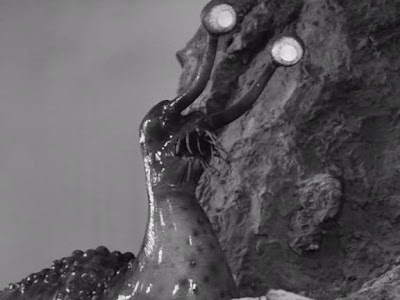
Yes, it's two men in suits throwing each other around, but for anyone who's run out of Godzilla movies to watch, Ultraman is the next best thing. Modified Godzilla suits even appear in the series, with added frills and paint jobs. The colourful, often fanciful, monster designs naturally lent themselves to extensive ranges of toys and merchandise. The most popular monsters re-appear in later series, a few becoming familiar icons in Japanese pop culture.
The first series of Ultraman is aimed at children, with hammy crew member Ide as a childish comedy relief, and a young boy in the regular cast. Ultraman sometimes even plays around with the monsters during fights, like riding on their backs (which just looks wrong to my fertile mind).
Like early Doctor Who, which influenced the series, there are a few quite frightening monsters (glowing eyes in the dark always work for me) and many incidental characters even die. Ultraman also disfigures, blinds or tears limbs off his monster opponents before killing them! These occasionally bloody displays seem at odds with the otherwise childish tone. The creatures sometimes die slowly, twitching in their death throes before finding peace. Later series would be far kinder to monsters (except the really bad ones), even relocating them back home, and very few human characters died.

Ultraman has beautiful miniature sets for the monsters to roam around in, but the aircraft models are far less intricate than Thunderbirds, shot in the UK the same year. I guess that having to keep the aircraft in scale with Ultraman meant that the model couldn't be as large as the Thunderbird models.
The budgets are quite large compared to many later series, with lots of extras running around, varied locations, and widescale action scenes.
A huge success, it lead to many more Ultraman TV series, which are still being produced, and some span off into movies, like Ultraman Next. It also inspired a boom in similar superhero shows from other studios, like Spectreman. Toei Studios' biggest hit scaled down the monster fights to human-size, pitching a roster of alien creatures against the beetleman biker hero, Kamen Rider.

Ultraman was dubbed into English and transmitted in the US. So the region 1 DVD set offers the English dub as well as an option for Japanese with subtitles. The picture looks extremely good, digitally remastered and restored, not looking its age at all. The set of 40 episodes was first released on six DVDs as two boxsets, but has already been re-released at a lower price on four DVDs.

It's a rare example of Ultraman on US DVD (Ultraman Tiga is the only other). I'd love to see the early follow-up, Ultraseven, with its tougher tone.
We never saw any Ultraman in the UK. So I first started watching it after discovering dozens of episodes on VCDs in Chinatown. While the earlier series have their charms, I prefer the revitalisation of the format that began with Ultraman Tiga, with it's better special FX and sleeker designs for the greatly expanded Earth defence fleet. With a variety of bases and launch procedures, the influence of Thunderbirds is still very evident.

Since Tiga, there's been a regular Ultraman series almost yearly, with year-round episodes. Last year there was another movie spin-off that brought back every previous incarnation of Ultraman for a Mega Monster Battle! It's just been released on DVD and Blu-Ray in Japan and Hong Kong.